Thursday, 7 May 2009

Saturday, 11 April 2009
Canto XXXIII. Dante and Beatrice walk on together. Beatrice prophesies that the wrongs done by secular power to the Church, and corruptions within the Church, will be put to rights. Matilda dips Dante in the River Eunoe, the twin of the Lethe, which restores his recollections of the good. He is now prepared for the third and final part of his journey.
Beatrice is Dante's God-bearing image. She is a figure of the Church, and of theology, and here she starts to instruct him. He struggles, in part because he is still overawed, but also because he is still in need of the full restoration of his memory in the Eunoe. Matilda is a figure of the active life, which prepares and enables us fully to participate in the contemplation of the mysteries of faith revealed through the Church. Even in the Earthly Paradise, Matilda has her role, of preparing and quickening the mind, building in it the facility to understand what the Church has to teach. In many ways, Lent is Matilda's season --- a season of preparation --- in which all our human capacities are prepared to celebrate the central mystery of the faith. In this way our journey up Mount Purgatory with Dante in Lent can prepare us too, to `mount up to the stars'.
Dante and Statius cross the Eunoe.
http://www.bodley.ox.ac.uk/dept/scwmss/wmss/medieval/jpegs/holkham/misc/48/1000/04800490.jpg
Beatrice is Dante's God-bearing image. She is a figure of the Church, and of theology, and here she starts to instruct him. He struggles, in part because he is still overawed, but also because he is still in need of the full restoration of his memory in the Eunoe. Matilda is a figure of the active life, which prepares and enables us fully to participate in the contemplation of the mysteries of faith revealed through the Church. Even in the Earthly Paradise, Matilda has her role, of preparing and quickening the mind, building in it the facility to understand what the Church has to teach. In many ways, Lent is Matilda's season --- a season of preparation --- in which all our human capacities are prepared to celebrate the central mystery of the faith. In this way our journey up Mount Purgatory with Dante in Lent can prepare us too, to `mount up to the stars'.
Dante and Statius cross the Eunoe.
http://www.bodley.ox.ac.uk/dept/scwmss/wmss/medieval/jpegs/holkham/misc/48/1000/04800490.jpg
Friday, 10 April 2009

Canto XXXI, XXXII. Beatrice continues to accuse Dante, who confesses his guilt. Matilda draws him through the stream, the Lethe, to Beatrice. Here he sleeps, then wakes to see a second pageant, in which the history of the Church is portrayed, and particularly its troubled relations with secular power. This masque takes place by the tree of knowledge, which is withered and dry, until the Griffon ties the cross-bar of the chariot to it, whereupon it bursts into flower, an image of the glory of the Cross and all it accomplished.
Beatrice's words to Dante set out the heart of his doctrine about love as a means to knowledge of God. His love for Beatrice "bore/Thy love along with it to seek the Good/Past which there's nothing to be eager for", yet after her death he was distracted and fell away. Dante expresses contrition, a reminder that this is a gift of the sacrament of confession, and Dante, now in the earthly paradise, has a greater horror of his past misdeeds than he could have had before.
The pageant of the Church in the Holkham MS.
http://www.bodley.ox.ac.uk/dept/scwmss/wmss/medieval/jpegs/holkham/misc/48/1000/04800487.jpg
Thursday, 9 April 2009
Cantos XXIX, XXX. Dante walks along the stream, following Matilda who is on the other side. After a while a masque approaches, with figures representing the books of the Old and New Testaments, the three theological virtues and the four cardinal virtues. A chariot is drawn by a griffin,dappled red and white in symbolism of both parts of the bible, the divine and human natures in Christ, and the bread and wine of the Eucharist. On this chariot is Beatrice. She reproaches Dante, who weeps.
Dorothy Sayers calls this first masque the Pageant of the Sacrament. It has the form of a Corpus Christi pageant, where the host would be carried on the chariot. It represents, in its figures, the Scriptures which point to the incarnation (Old Testament) and attest to it directly (New Testament). The griffin symbolizes this unity of the scripture, the two-fold nature of Christ, and the sacrament through which we can participate in that mystery directly. However, in this case, Beatrice rides in the Chariot. She is Dante’s own God-bearing image, the sign which first pointed him to God. She is also a symbol of the Church, the mystical body of Christ, and so stands in for the Body of Christ in a sacramental procession. In the second of the two Cantos she speaks plainly of how Dante’s natural talents, and the gift he had been given in his first vision of her, have been squandered. He has, by grace, been brought to this place where man is happy, i.e. where fully human flourishing is possible, but must recognize how he has strayed in the past, and repent.
Today, Holy Thursday, we look back to the upper room, and the institution of the Eucharist, when Christ gave us the sacrament of his body and blood. All symbols draw us to this one, which both shows us the presence of Christ, and makes it real. We have been brought, via the slopes of Mount Purgatory, to this pivotal moment between the Old and New Testament stories, and to the verge of the events of Good Friday which change everything.
Dorothy Sayers calls this first masque the Pageant of the Sacrament. It has the form of a Corpus Christi pageant, where the host would be carried on the chariot. It represents, in its figures, the Scriptures which point to the incarnation (Old Testament) and attest to it directly (New Testament). The griffin symbolizes this unity of the scripture, the two-fold nature of Christ, and the sacrament through which we can participate in that mystery directly. However, in this case, Beatrice rides in the Chariot. She is Dante’s own God-bearing image, the sign which first pointed him to God. She is also a symbol of the Church, the mystical body of Christ, and so stands in for the Body of Christ in a sacramental procession. In the second of the two Cantos she speaks plainly of how Dante’s natural talents, and the gift he had been given in his first vision of her, have been squandered. He has, by grace, been brought to this place where man is happy, i.e. where fully human flourishing is possible, but must recognize how he has strayed in the past, and repent.
Today, Holy Thursday, we look back to the upper room, and the institution of the Eucharist, when Christ gave us the sacrament of his body and blood. All symbols draw us to this one, which both shows us the presence of Christ, and makes it real. We have been brought, via the slopes of Mount Purgatory, to this pivotal moment between the Old and New Testament stories, and to the verge of the events of Good Friday which change everything.
Wednesday, 8 April 2009
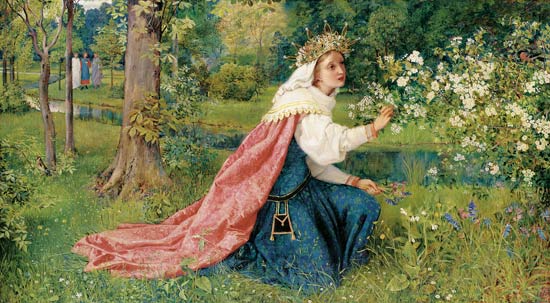
Canto XXVIII. Dante walks into the earthly paradise, where he meets a lady, Matilda, who is separated from him by a stream. She tells him that the place is the first home of humankind, and singularly blessed. It is kept from irregularities of weather and seasons by its height; and is in a perpetual spring. The soil is full of seeds of plants as yet unknown. Through the forest flow two streams: Lethe (which obliterates memories of sin) and Eunoe (which restores memory of the good).
Matilda is seen gathering flowers, which links her to Leah in Dante’s previous dream. Leah was a type of the active life, and it is suggested that Matilda represents the perfection of earthly life in the earthly paradise. The earthly paradise, Eden, is a place where man enjoyed God’s friendship and ‘original beatitude’, the enjoyment of a life beyond his natural capacities. This was lost through sin, and man was then even unable fully to achieve natural goodness. Dante has returned to Eden, but this is not the end of his journey. Salvation is not simply restoration of a primal state, but rather a journey beyond it to share in the life of God through the vision of the Trinity. This gift is possible through our being joined to Christ, a result of his incarnation, sacrifice and resurrection, in which we now share sacramentally, in anticipation of that final vision. In short, our destination, by mercy and grace, is even more wonderful than the Eden that Dante portrays in this Canto.
George Dunlop Leslie's Matilda
https://www.copia-di-arte.com/kunst/noartist/c/hi/chr-vic10060310301.jpg
Matilda is seen gathering flowers, which links her to Leah in Dante’s previous dream. Leah was a type of the active life, and it is suggested that Matilda represents the perfection of earthly life in the earthly paradise. The earthly paradise, Eden, is a place where man enjoyed God’s friendship and ‘original beatitude’, the enjoyment of a life beyond his natural capacities. This was lost through sin, and man was then even unable fully to achieve natural goodness. Dante has returned to Eden, but this is not the end of his journey. Salvation is not simply restoration of a primal state, but rather a journey beyond it to share in the life of God through the vision of the Trinity. This gift is possible through our being joined to Christ, a result of his incarnation, sacrifice and resurrection, in which we now share sacramentally, in anticipation of that final vision. In short, our destination, by mercy and grace, is even more wonderful than the Eden that Dante portrays in this Canto.
George Dunlop Leslie's Matilda
https://www.copia-di-arte.com/kunst/noartist/c/hi/chr-vic10060310301.jpg
Tuesday, 7 April 2009
Canto XXVII. Dante, Statius and Virgil are called by the angel of the cornice to walk through the flames to attain the pass. Dante is terrified, but Virgil urges him on, telling him that Beatrice is on the other side. The angel pronounces the benediction of the pass. Dante’s brow is now clear of all the ‘P’s. With the setting of the sun the poets have to spend the night on the pass, where Dante dreams of Leah and Rachel, the wives of Jacob and types of the active and reflective life. With dawn the poets press on, and Virgil pronounces Dante now master of his own soul.
Iris Murdoch wrote that `Love is the difficult realization that something other than oneself is real.’ Love of another person can draw us out of self-obsession into an awareness of the reality, the needs and the flourishing of another person. For Dante it does not, or need not, stop there. Love can draw us on to an awareness of the One who created the beloved, and of whose glory the beloved is a reflection. This is why his boyhood encounter with Beatrice in Florence was a pivotal experience, providing the key dramatic mechanism of the Divine Comedy. It is by Beatrice’s intercession that Dante is granted his salutory experience of Hell, Purgatory and Paradise, and it is Beatrice, as the figure of theology and the Church, who is to conduct him almost as far as his momentary glimpse of the beatific vision. At this stage we see how Dante’s love for Beatrice enables him to overcome his fear of the fire of the lustful, through which all souls must pass to leave Purgatory and attain the earthly paradise.
Dante’s theology of love is radical and audacious. A young woman of Florence becomes a type of theology, of the Church, of Christ himself; a God-bearing image for Dante in Dorothy Sayers’s expression. This idea is not unique. Perhaps something of it lies behind Chesterton’s words in the dedication to the Ballad of the White Horse:
`Lady, by one light only
We look from Alfred's eyes,
We know he saw athwart the wreck
The sign that hangs about your neck,
Where One more than Melchizedek
Is dead and never dies.
Therefore I bring these rhymes to you,
Who brought the cross to me,
Since on you flaming without flaw
I saw the sign that Guthrum saw
When he let break his ships of awe,
And laid peace on the sea. ….
And I thought, " I will go with you,
As man with God has gone,
And wander with a wandering star,
The wandering heart of things that are,
The fiery cross of love and war
That like yourself, goes on."
O go you onward ; where you are
Shall honour and laughter be,
Past purple forest and pearled foam,
God's winged pavilion free to roam,
Your face, that is a wandering home,
A flying home for me.’
The idea was developed by Charles Williams in his Arthurian Poems Taliessin Through Logres and The Region of Summer Stars. For Williams the vision of the beloved can be a `Beatrician moment’ of insight, which can draw us on to God. Consider, for example, the experience of the saracen Palomides, when he sees Isolde theQueen of Cornwall:
`Blessed (I sang) the Cornish queen;
for till to-day no eyes have seen
how curves of golden life define
the straightness of a perfect line,
till the queen's blessed arm became
a rigid bar of golden flame
where well might Archimedes prove
the doctrine of Euclidean love
and draw his demonstrations right
against the unmathematic night
of ignorance and indolence’
For Williams geometry is a figure for knowledge of God, here, as elsewhere in his poem, glimpsed in the form of the beloved.
But Williams is not naïve. His account of love, like Dante’s, is not shallow and vacuous, in the manner of John Lennon and the Beatles. He knows that a gap can emerge between the love of the person and the love of God to which the glory of the beloved can point us. How this is handled is critical. For Palomides there is initial failure and conflict, only eventually redeemed (in his baptism) after he has missed the central quest of the Table, for the Holy Grail. By contrast, for the court poet Taliessin, and his beloved the Lady Dindrane, love leads on to a deeper engagement with the demands of life: for him in his household, the court, and the quest; for her in the cloister and a final quest of her own.
We have seen on the mountain that all movements of the soul towards goods are love, which can go astray. This is why all souls must pass, if only briefly, through the fire of the seventh cornice. At its best the love of another person can be the means by which all our loves can be opened to Divine charity, and so become integrated, and the foundation of our wholeness.
Iris Murdoch wrote that `Love is the difficult realization that something other than oneself is real.’ Love of another person can draw us out of self-obsession into an awareness of the reality, the needs and the flourishing of another person. For Dante it does not, or need not, stop there. Love can draw us on to an awareness of the One who created the beloved, and of whose glory the beloved is a reflection. This is why his boyhood encounter with Beatrice in Florence was a pivotal experience, providing the key dramatic mechanism of the Divine Comedy. It is by Beatrice’s intercession that Dante is granted his salutory experience of Hell, Purgatory and Paradise, and it is Beatrice, as the figure of theology and the Church, who is to conduct him almost as far as his momentary glimpse of the beatific vision. At this stage we see how Dante’s love for Beatrice enables him to overcome his fear of the fire of the lustful, through which all souls must pass to leave Purgatory and attain the earthly paradise.
Dante’s theology of love is radical and audacious. A young woman of Florence becomes a type of theology, of the Church, of Christ himself; a God-bearing image for Dante in Dorothy Sayers’s expression. This idea is not unique. Perhaps something of it lies behind Chesterton’s words in the dedication to the Ballad of the White Horse:
`Lady, by one light only
We look from Alfred's eyes,
We know he saw athwart the wreck
The sign that hangs about your neck,
Where One more than Melchizedek
Is dead and never dies.
Therefore I bring these rhymes to you,
Who brought the cross to me,
Since on you flaming without flaw
I saw the sign that Guthrum saw
When he let break his ships of awe,
And laid peace on the sea. ….
And I thought, " I will go with you,
As man with God has gone,
And wander with a wandering star,
The wandering heart of things that are,
The fiery cross of love and war
That like yourself, goes on."
O go you onward ; where you are
Shall honour and laughter be,
Past purple forest and pearled foam,
God's winged pavilion free to roam,
Your face, that is a wandering home,
A flying home for me.’
The idea was developed by Charles Williams in his Arthurian Poems Taliessin Through Logres and The Region of Summer Stars. For Williams the vision of the beloved can be a `Beatrician moment’ of insight, which can draw us on to God. Consider, for example, the experience of the saracen Palomides, when he sees Isolde theQueen of Cornwall:
`Blessed (I sang) the Cornish queen;
for till to-day no eyes have seen
how curves of golden life define
the straightness of a perfect line,
till the queen's blessed arm became
a rigid bar of golden flame
where well might Archimedes prove
the doctrine of Euclidean love
and draw his demonstrations right
against the unmathematic night
of ignorance and indolence’
For Williams geometry is a figure for knowledge of God, here, as elsewhere in his poem, glimpsed in the form of the beloved.
But Williams is not naïve. His account of love, like Dante’s, is not shallow and vacuous, in the manner of John Lennon and the Beatles. He knows that a gap can emerge between the love of the person and the love of God to which the glory of the beloved can point us. How this is handled is critical. For Palomides there is initial failure and conflict, only eventually redeemed (in his baptism) after he has missed the central quest of the Table, for the Holy Grail. By contrast, for the court poet Taliessin, and his beloved the Lady Dindrane, love leads on to a deeper engagement with the demands of life: for him in his household, the court, and the quest; for her in the cloister and a final quest of her own.
We have seen on the mountain that all movements of the soul towards goods are love, which can go astray. This is why all souls must pass, if only briefly, through the fire of the seventh cornice. At its best the love of another person can be the means by which all our loves can be opened to Divine charity, and so become integrated, and the foundation of our wholeness.
Monday, 6 April 2009
Canto XXVI. On the seventh cornice of Purgatory the lustful are purged, running through fire. Dante meets the shade of Guido Guinicelli, a prominent Italian poet, whose innovative ‘sweet new style’ Dante and others followed. Those guilty of natural and unnatural lusts run in opposite directions, crying out the bridle of their respective lusts, and exchanging embraces as they pass.
It always strikes me as curious that part of the penance of the lustful is exchanging embraces with their fellows as they pass; ‘some penance,’ one might say. Dorothy Sayers’s comment that ‘the image of the sin is also the image and means of the remedy’ seems, at first glance, to miss the mark. Take the avaricious as a contrast. They endure the turning of their attention away from heaven towards the things of earth, as a means of breaking the attachments that their disordered love of wealth created during life. How does running through flames, while exchanging embraces with one’s fellows do the same for lust?
Perhaps the purification of our loves requires, ultimately, that our natural love becomes a sharing in Divine charity. As such that becomes a love for all God’s creatures, a delight in them all. In our earthly life the deepest love is properly reserved to one other. When it is ultimately transformed by Charity it becomes, properly, addressed to all. That purification requires our breaking the attachments of disordered love – obsessiveness, unreason – which hold them in thrall.
The Bodleian’s collection of illustrations from Purgatorio misses this Canto and a number that follow.
It always strikes me as curious that part of the penance of the lustful is exchanging embraces with their fellows as they pass; ‘some penance,’ one might say. Dorothy Sayers’s comment that ‘the image of the sin is also the image and means of the remedy’ seems, at first glance, to miss the mark. Take the avaricious as a contrast. They endure the turning of their attention away from heaven towards the things of earth, as a means of breaking the attachments that their disordered love of wealth created during life. How does running through flames, while exchanging embraces with one’s fellows do the same for lust?
Perhaps the purification of our loves requires, ultimately, that our natural love becomes a sharing in Divine charity. As such that becomes a love for all God’s creatures, a delight in them all. In our earthly life the deepest love is properly reserved to one other. When it is ultimately transformed by Charity it becomes, properly, addressed to all. That purification requires our breaking the attachments of disordered love – obsessiveness, unreason – which hold them in thrall.
The Bodleian’s collection of illustrations from Purgatorio misses this Canto and a number that follow.
Friday, 3 April 2009
Canto XXV. As the poets proceed up the pass to the final cornice Dante asks Virgil how it is that the souls of the gluttonous can appear emaciated when they are not embodied. Virgil asks Statius to explain, and much of the canto is Statius’s discourse, which sets out an Aristotelian account of the human soul. The poets then reach the cornice of the lustful, where the souls run through fire, reciting classical and scriptural examples of chastity.
Statius gives Dante an extended account of the origin of the human soul. This is based on Aristotle’s account of substances (hylomorphism), as Christianized in the writing of St Thomas. It is important to remember that, in Aristotle’s account of form and matter, these are not components of a substance (as gin and tonic are components of a drink), but rather are the substance considered under different aspects: what constrains the substance to be this kind of thing, rather than another (form), and what makes a particular substance this instance, subject to change, rather than another instance of the same thing (matter). The human soul is pure form. It gives the individual human capacity to grow (the vegetative soul) and to respond actively to its environment (the animal soul), but also gives it the rational attributes: memory, mind and will. None of these can be adequately explained in material terms (although they require our bodies for their functioning). The human being is a unity of soul and body, again not as two components but rather a whole considered under two aspects. The souls that Dante meets are ‘shades’, less than fully human in that they are not embodied humanly, but only in a perturbation of the light. ‘My soul is not me’ in St Thomas’s slogan. At the same time, I cannot fully account for the capacity of the rational soul in material terms. This is not an argument for a ‘ghost in the machine.’ Rather it is the recognition that, for example, my sense of the meaning of a word cannot depend on some internal, privately-owned, sensation, if it is to be a shared meaning with others.
Our devotional reading of Dante need not become hung-up on the Aristotelian and medieval account of substance, or its details of embryology. What matters is the recognition that to be human is to be a particular kind of creature with special capacities and potentials, which can be exercised for good or ill. It is the movement of the will, directed by the mind, which develops vice and virtue in the whole person; and we, having come from God our creator, can impede or co-operate with His eternal will which draws us back to Himself.
Statius speaking to Dante
http://www.bodley.ox.ac.uk/dept/scwmss/wmss/medieval/jpegs/holkham/misc/48/1000/04800484.jpg
Statius gives Dante an extended account of the origin of the human soul. This is based on Aristotle’s account of substances (hylomorphism), as Christianized in the writing of St Thomas. It is important to remember that, in Aristotle’s account of form and matter, these are not components of a substance (as gin and tonic are components of a drink), but rather are the substance considered under different aspects: what constrains the substance to be this kind of thing, rather than another (form), and what makes a particular substance this instance, subject to change, rather than another instance of the same thing (matter). The human soul is pure form. It gives the individual human capacity to grow (the vegetative soul) and to respond actively to its environment (the animal soul), but also gives it the rational attributes: memory, mind and will. None of these can be adequately explained in material terms (although they require our bodies for their functioning). The human being is a unity of soul and body, again not as two components but rather a whole considered under two aspects. The souls that Dante meets are ‘shades’, less than fully human in that they are not embodied humanly, but only in a perturbation of the light. ‘My soul is not me’ in St Thomas’s slogan. At the same time, I cannot fully account for the capacity of the rational soul in material terms. This is not an argument for a ‘ghost in the machine.’ Rather it is the recognition that, for example, my sense of the meaning of a word cannot depend on some internal, privately-owned, sensation, if it is to be a shared meaning with others.
Our devotional reading of Dante need not become hung-up on the Aristotelian and medieval account of substance, or its details of embryology. What matters is the recognition that to be human is to be a particular kind of creature with special capacities and potentials, which can be exercised for good or ill. It is the movement of the will, directed by the mind, which develops vice and virtue in the whole person; and we, having come from God our creator, can impede or co-operate with His eternal will which draws us back to Himself.
Statius speaking to Dante
http://www.bodley.ox.ac.uk/dept/scwmss/wmss/medieval/jpegs/holkham/misc/48/1000/04800484.jpg
Thursday, 2 April 2009
Canto XXIV. Dante and his companions continue on their way, Dante still speaking with Forese. They find a second tree, where the souls undergoing purgation hear a voice recite the bridle of gluttony. Dante is told that this second tree is a descendant of the tree of knowledge, `the tree that fed that greed of Eve’ in the words of the voice that speaks the bridle. The angel of temperance wipes a further ‘P’ from Dante’s brow, and he, Virgil and Statius continue up the pass.
Dante has relatively little to say about gluttony, as such, and in this Canto a good deal of the talk is about Florence, and poetry. Dante’s poetry on love is foundational to the Divine Comedy, and we shall see more about that in later Cantos. Perhaps he has the liberty to discuss his poetry this close to the top of the mountain precisely because of the importance of his understanding of love to the rest of the narrative, whereas at the bottom (see Canto 2) verse and song was a distraction for the newly-arrived souls, who were chastised by Cato.
Dante meets the Angel of Temperance.
http://www.bodley.ox.ac.uk/dept/scwmss/wmss/medieval/jpegs/holkham/misc/48/1000/04800483.jpg
Dante has relatively little to say about gluttony, as such, and in this Canto a good deal of the talk is about Florence, and poetry. Dante’s poetry on love is foundational to the Divine Comedy, and we shall see more about that in later Cantos. Perhaps he has the liberty to discuss his poetry this close to the top of the mountain precisely because of the importance of his understanding of love to the rest of the narrative, whereas at the bottom (see Canto 2) verse and song was a distraction for the newly-arrived souls, who were chastised by Cato.
Dante meets the Angel of Temperance.
http://www.bodley.ox.ac.uk/dept/scwmss/wmss/medieval/jpegs/holkham/misc/48/1000/04800483.jpg
Wednesday, 1 April 2009
Canto XXIII. The three poets continue their progress around the cornice, and meet the souls of the gluttonous, who are emaciated. One, Forese Donati, is a friend of Dante, and explains that he has made rapid progress up the mountain because of the prayers of his widow. He prophesies Dante’s problems in Florence, and punishments for that city.
In the Summa Theologiae (1a.2ae.148.1) St Thomas asks whether gluttony really is a sin. Afterall, the drive towards food and drink is a basic human instinct. He concludes that it is, because the root and beginning of the sin is not in the drive itself, but begins when this becomes detached from reason. ‘Gluttony denotes, not any desire of eating and drinking, but an inordinate desire.’ By inordinate desire he means that which ‘ leav[es] the order of reason, wherein the good of moral virtue consists: and a thing is said to be a sin through being contrary to virtue.’ From what we have seen before, we might depart from virtuous use of food and drink in various ways. Mostly we tend to eat too much, but I once heard a Dominican friar give the example of someone who, at a surprise party, fails to join in whole-heartedly. This too is a failure in temperance, and is a sin which might be purged amid the gluttonous.
Forese shows Dante the tree of the gluttonous.
http://www.bodley.ox.ac.uk/dept/scwmss/wmss/medieval/jpegs/holkham/misc/48/1000/04800481.jpg
In the Summa Theologiae (1a.2ae.148.1) St Thomas asks whether gluttony really is a sin. Afterall, the drive towards food and drink is a basic human instinct. He concludes that it is, because the root and beginning of the sin is not in the drive itself, but begins when this becomes detached from reason. ‘Gluttony denotes, not any desire of eating and drinking, but an inordinate desire.’ By inordinate desire he means that which ‘ leav[es] the order of reason, wherein the good of moral virtue consists: and a thing is said to be a sin through being contrary to virtue.’ From what we have seen before, we might depart from virtuous use of food and drink in various ways. Mostly we tend to eat too much, but I once heard a Dominican friar give the example of someone who, at a surprise party, fails to join in whole-heartedly. This too is a failure in temperance, and is a sin which might be purged amid the gluttonous.
Forese shows Dante the tree of the gluttonous.
http://www.bodley.ox.ac.uk/dept/scwmss/wmss/medieval/jpegs/holkham/misc/48/1000/04800481.jpg
Tuesday, 31 March 2009
Canto XXII. After the poets have climbed up to the next terrace, Virgil and Statius converse together. Statius explains that he has spent time on the cornice of avarice, not because of avarice as commonly understood, but because of its opposite: an excessive prodigality. He explains how Virgil’s poetry inspired him to seek out Christian preachers, and how he was therefore converted. After a while the poets come upon souls of the gluttonous, and here the whip of gluttony: which includes an account of Our Lady’s concern for the guests and hosts of the wedding at Cana.
James Thurber’s story of The Bear Who Let it Alone is an account of a drunken bear who becomes a strict teetotaler and temperance lecturer. Neither conditions makes for domestic happiness, so Thurber concludes: 'You might as well fall at on your face than lean over too far backward'. We saw in Canto XVI that vice consists in falling away from virtue, and that this can happen in more than one direction. Statius explains here that, although typically humans depart from proper use of worldy goods by hoarding them for themselves, it is also possible (if less common) to diverge the opposite way, into prodigality. Both sins are purged together.
A Methodist minister I know once preached that, in failing to deal maturely with the fact of our own sinfulness, we typically either become permissive (explaining our sin away) or we become particularly condemnatory of others who fail more spectacularly and/or in different ways from us; ‘at least I’m not as bad as him..’. Perhaps in Lent we should pay attention to our own attitudes. Maybe a corollary of his observation is that we are particularly hot on others’ sins when these diverge from virtue in opposite directions to our own failings.
The poets come upon the tree of the gluttonous.
http://www.bodley.ox.ac.uk/dept/scwmss/wmss/medieval/jpegs/holkham/misc/48/1000/04800479.jpg
James Thurber’s story of The Bear Who Let it Alone is an account of a drunken bear who becomes a strict teetotaler and temperance lecturer. Neither conditions makes for domestic happiness, so Thurber concludes: 'You might as well fall at on your face than lean over too far backward'. We saw in Canto XVI that vice consists in falling away from virtue, and that this can happen in more than one direction. Statius explains here that, although typically humans depart from proper use of worldy goods by hoarding them for themselves, it is also possible (if less common) to diverge the opposite way, into prodigality. Both sins are purged together.
A Methodist minister I know once preached that, in failing to deal maturely with the fact of our own sinfulness, we typically either become permissive (explaining our sin away) or we become particularly condemnatory of others who fail more spectacularly and/or in different ways from us; ‘at least I’m not as bad as him..’. Perhaps in Lent we should pay attention to our own attitudes. Maybe a corollary of his observation is that we are particularly hot on others’ sins when these diverge from virtue in opposite directions to our own failings.
The poets come upon the tree of the gluttonous.
http://www.bodley.ox.ac.uk/dept/scwmss/wmss/medieval/jpegs/holkham/misc/48/1000/04800479.jpg
Monday, 30 March 2009
Canto XXI. The poets continue on their way, and are overtaken by a soul who identifies himself as the poet Statius. He explains how he has just completed his purgation on the cornice of avarice, and how this release was accompanied by the shaking of the moutain, and exultant cries from all the souls.
In Newman’s The Dream of Gerontius the soul of Gerontius, after enduring the vision of God, says
`Take me away, and in the lowest deep
There let me be,
And there in hope the lone night-watches keep,
Told out for me.’
In short, his purgation is a matter of his own will. It is by the will, says St Thomas, that man is joined to God, and so the will does not merely accept, but desires that purging of the attachments to sin which is the business of Purgatory. Purgatory is a punishment in a Pickwickian sense, St Thomas writes that `the nature of punishment is to be against the will’ (Summa Theologiae 1.2ae.87.7), while the punishment of Purgatory is something the will desires, because its overriding aim is the union with God, which both achieves and requires detachment from sin.
This is why Statius tells Dante and Virgil that it is the soul’s own will which knows when purgation is complete, until that moment it embraces the punishment which is the means to its final end. Our penance is a practice run for this willed and embraced detachment from sin and return to our origin in God, a fitting reflection to begin the last two weeks of Lent, traditionally the beginning of Passiontide.
Dante and Virgil converse with the soul of Statius.
http://www.bodley.ox.ac.uk/dept/scwmss/wmss/medieval/jpegs/holkham/misc/48/1000/04800476.jpg
In Newman’s The Dream of Gerontius the soul of Gerontius, after enduring the vision of God, says
`Take me away, and in the lowest deep
There let me be,
And there in hope the lone night-watches keep,
Told out for me.’
In short, his purgation is a matter of his own will. It is by the will, says St Thomas, that man is joined to God, and so the will does not merely accept, but desires that purging of the attachments to sin which is the business of Purgatory. Purgatory is a punishment in a Pickwickian sense, St Thomas writes that `the nature of punishment is to be against the will’ (Summa Theologiae 1.2ae.87.7), while the punishment of Purgatory is something the will desires, because its overriding aim is the union with God, which both achieves and requires detachment from sin.
This is why Statius tells Dante and Virgil that it is the soul’s own will which knows when purgation is complete, until that moment it embraces the punishment which is the means to its final end. Our penance is a practice run for this willed and embraced detachment from sin and return to our origin in God, a fitting reflection to begin the last two weeks of Lent, traditionally the beginning of Passiontide.
Dante and Virgil converse with the soul of Statius.
http://www.bodley.ox.ac.uk/dept/scwmss/wmss/medieval/jpegs/holkham/misc/48/1000/04800476.jpg
Friday, 27 March 2009
Canto XX The poets proceed around the mountain, and hear a voice of one of the avaricious calling out the whip of the cornice, examples of virtuous poverty. Dante approaches the speaker, who is Hugh Capet, origin of the Capetian house of Kings of France. He castigates his descendants.
Hugh Capet’s denunciation of the members of his house show that avarice is not only the disordered desire for material goods, but also for power. This is significant, given Dante’s political concerns. It was the Capetian Charles of Valois whose intervention in Florence lead to the downfall of the ‘white’ Guelfs, and with them Dante himself, but more to the point the Capetians were rivals to the Holy Roman Emperor, and promoted the Papal cause with a view to limiting Imperial power. Today I sat in a meeting where important matters were discussed which potentially impact on the lives and families of individual people. Power has to be exercised, and sometimes hard choices must be made. Hugh Capet’s discourse, about the exercise of power on a grand scale, reminds us that the power we exercise at any level is easily misused. The pursuit of power for its own sake can result in damage to others, and ultimately to ourselves.
Dante speaks with Hugh Capet
http://www.bodley.ox.ac.uk/dept/scwmss/wmss/medieval/jpegs/holkham/misc/48/1000/04800474.jpg
Hugh Capet’s denunciation of the members of his house show that avarice is not only the disordered desire for material goods, but also for power. This is significant, given Dante’s political concerns. It was the Capetian Charles of Valois whose intervention in Florence lead to the downfall of the ‘white’ Guelfs, and with them Dante himself, but more to the point the Capetians were rivals to the Holy Roman Emperor, and promoted the Papal cause with a view to limiting Imperial power. Today I sat in a meeting where important matters were discussed which potentially impact on the lives and families of individual people. Power has to be exercised, and sometimes hard choices must be made. Hugh Capet’s discourse, about the exercise of power on a grand scale, reminds us that the power we exercise at any level is easily misused. The pursuit of power for its own sake can result in damage to others, and ultimately to ourselves.
Dante speaks with Hugh Capet
http://www.bodley.ox.ac.uk/dept/scwmss/wmss/medieval/jpegs/holkham/misc/48/1000/04800474.jpg
Thursday, 26 March 2009
Canto XIX Dante has a dream of the siren, who lured sailors to destruction. A woman intervenes, calling to Virgil who unmasks the siren. Virgil wakes Dante, and they proceed to the pass up to the next cornice. Here the avaricious lie, their backs to heaven. Dante speaks with one, the soul of Pope Adrian V.
On the three remaining cornices of Purgatory are purged the sins arising from disordered love-proper. On the lower terraces the sins result from a negative self-love, or from inadequate zeal in love. From now on our concern is with loves of objects, good in themselves, but for which our loves need to be ordered and restrained. As Dorothy Sayers says in her commentary, the objects of these disordered loves are not bad in themselves, so the siren cannot be an image of them. Rather she represents the object of a distorted self-love: the image of ourselves as somehow completed by the wealth or pleasure that we might pursue. It is this that lies at the root of disorder in our loves.
The woman who intervenes can be thought of as an image of virtue, a tendency or disposition to a proper ordering of our capacities. Virtue calls on reason (of which Virgil is the figure throughout Dante's poem), and he unmasks the siren. In short, by properly trained dispositions, we are able to see the reality of our situation. Wealth, for example, will not complete our happiness, which only God can fulfil; and when we exercise reason we see how avaricious pursuit of wealth could undo other goods (justice, for example) which we should pursue. Virtue, however, must be enlivened by Charity, if it is to be effective, so an account of the good life in the purely psychological terms of Dante's dream is not entirely satisfactory.
Dante's dream of the siren
http://www.bodley.ox.ac.uk/dept/scwmss/wmss/medieval/jpegs/holkham/misc/48/1000/04800471.jpg
On the three remaining cornices of Purgatory are purged the sins arising from disordered love-proper. On the lower terraces the sins result from a negative self-love, or from inadequate zeal in love. From now on our concern is with loves of objects, good in themselves, but for which our loves need to be ordered and restrained. As Dorothy Sayers says in her commentary, the objects of these disordered loves are not bad in themselves, so the siren cannot be an image of them. Rather she represents the object of a distorted self-love: the image of ourselves as somehow completed by the wealth or pleasure that we might pursue. It is this that lies at the root of disorder in our loves.
The woman who intervenes can be thought of as an image of virtue, a tendency or disposition to a proper ordering of our capacities. Virtue calls on reason (of which Virgil is the figure throughout Dante's poem), and he unmasks the siren. In short, by properly trained dispositions, we are able to see the reality of our situation. Wealth, for example, will not complete our happiness, which only God can fulfil; and when we exercise reason we see how avaricious pursuit of wealth could undo other goods (justice, for example) which we should pursue. Virtue, however, must be enlivened by Charity, if it is to be effective, so an account of the good life in the purely psychological terms of Dante's dream is not entirely satisfactory.
Dante's dream of the siren
http://www.bodley.ox.ac.uk/dept/scwmss/wmss/medieval/jpegs/holkham/misc/48/1000/04800471.jpg
Wednesday, 25 March 2009
Canto XVIII. While Dante and Virgil sit in the darkness, Dante questions his guide about love. Virgil explains that we have freedom of choice in responding to our loves, and so can be held accountable for how we order them. The moon rises and, as Dante is drifting into sleep, the poets hear an approaching band of the slothful. These are running around the cornice and crying out examples of zeal and sloth. One, a former Abbot, directs the poets to the pass.
It is a happy coincidence that, in 2009, this Canto falls on the feast of the Annunciation. The first example of zeal in the whip of sloth, which the souls themselves call out, is ‘Mary hastened to the hills’. This is a quotation from Luke’s Gospel describing how, immediately after Gabriel’s visit, Mary set out to visit her cousin Elizabeth. Representations of the Annunciation, such as Fra Angelico’s (see link below), generally show Our Lady interrupted in meditation, prayer or reading. Maybe such leisure was unlikely in the life of a poor Palestinian woman in her time. Nonetheless, the artist captures a capacity for meditative openness to God, which was clearly part of Our Lady’s character in the Gospel. The other side of the coin is the haste with which she then sets out to visit Elizabeth, and to stay with her till the birth of John. The link between these two states of her being --- still and receptive at one moment, active and purposeful the next --- is her ‘Fiat’, ‘let it be’, with which she greets the angel’s news.
The vanishing point in Fra Angelico’s perspective draws our eye through a window to the outside world. Our Lady is called to play her part in a story which will lead her into that world, through the uncertainty of pregnancy, the poverty of the stable, the wonder of the Epiphany, the exile in Egypt, the anxiety of the visit to Jerusalem, and to the foot of the cross.
Sloth takes various forms. There is simple idleness, there is ‘accidie’ or hopelessness which paralyses the will, there is the temptation to withdraw into a quieter and easier life. Perhaps it is also a form of sloth to conceal our lack of engagement with the actual demands of faith and life with a pointless business. Mary took on her vocation in hope and faith, despite the uncertainty it brought her, and persisted to the end. This is the example of zeal which the souls in Dante set before themselves, and offer to us this Lent.
Fra Angelico’s Annunciation
http://en.wikipedia.org/wiki/File:Fra_Angelico_043.jpg
Dante and Virgil meet the slothful in the Holkham MS.
http://www.bodley.ox.ac.uk/dept/scwmss/wmss/medieval/jpegs/holkham/misc/48/1000/04800470.jpg
It is a happy coincidence that, in 2009, this Canto falls on the feast of the Annunciation. The first example of zeal in the whip of sloth, which the souls themselves call out, is ‘Mary hastened to the hills’. This is a quotation from Luke’s Gospel describing how, immediately after Gabriel’s visit, Mary set out to visit her cousin Elizabeth. Representations of the Annunciation, such as Fra Angelico’s (see link below), generally show Our Lady interrupted in meditation, prayer or reading. Maybe such leisure was unlikely in the life of a poor Palestinian woman in her time. Nonetheless, the artist captures a capacity for meditative openness to God, which was clearly part of Our Lady’s character in the Gospel. The other side of the coin is the haste with which she then sets out to visit Elizabeth, and to stay with her till the birth of John. The link between these two states of her being --- still and receptive at one moment, active and purposeful the next --- is her ‘Fiat’, ‘let it be’, with which she greets the angel’s news.
The vanishing point in Fra Angelico’s perspective draws our eye through a window to the outside world. Our Lady is called to play her part in a story which will lead her into that world, through the uncertainty of pregnancy, the poverty of the stable, the wonder of the Epiphany, the exile in Egypt, the anxiety of the visit to Jerusalem, and to the foot of the cross.
Sloth takes various forms. There is simple idleness, there is ‘accidie’ or hopelessness which paralyses the will, there is the temptation to withdraw into a quieter and easier life. Perhaps it is also a form of sloth to conceal our lack of engagement with the actual demands of faith and life with a pointless business. Mary took on her vocation in hope and faith, despite the uncertainty it brought her, and persisted to the end. This is the example of zeal which the souls in Dante set before themselves, and offer to us this Lent.
Fra Angelico’s Annunciation
http://en.wikipedia.org/wiki/File:Fra_Angelico_043.jpg
Dante and Virgil meet the slothful in the Holkham MS.
http://www.bodley.ox.ac.uk/dept/scwmss/wmss/medieval/jpegs/holkham/misc/48/1000/04800470.jpg
Tuesday, 24 March 2009
Canto XVII. Dante and Virgil leave the cloud around the wrathful. Dante has a vision of the bridle of purgatory, examples of those who gave in to wrath, including Haman whose story is told in the book of Esther. The angel of the cornice wipes a further ‘P’ from Dante’s brow and directs the poets to the pass. On their ascending to the next cornice, night falls, and they can no longer move (see Canto VII). Virgil explains to Dante the principle by which the cornices of purgatory are ordered.
A child might say ‘I love ice-cream’. A man might say ‘I love you’ to his wife. At the baptism of Christ the voice from the cloud said ‘this is my beloved son’. We might hesitate to say that the verb ‘to love’ is used the same way in all three cases. But we would also hesistate before saying the uses are quite unconnected. The sense in which they are the same is what St Thomas Aquinas calls analogy. My will, the faculty by which I seek something perceived as good, is the seat of love, although it is also directed by the mind (which makes the evaluation). So my pursuit of some good is a love. (This must mean something different in God, since my seeing and loving something is a change in me).
Virgil explains that no-one can truly hate themselves (since they cannot will anything other than a good for themselves) nor can they truly hate God (who is their origin). Therefore the lowest of the sins are loves of others’ harm. The proud do so because they see their neighbour’s diminshment as their own advancement. The envious wish ill to their neighbours out of fear of what they might lose themselves. The wrathful desire other’s harm in an irrational emotional response to some hurt they receive themselves. These are the cornices already visited. Dante and Virgil have just reached the cornice where the souls have been inadequately zealous in the pursuit of good loves (the slothfull). On higher terraces are found those whose pursuit of loves has been excessive.
We have already noted that Dante’s strong systematizing of sin, while poetically necessary, and perhaps didactically necessary, needs to be treated with caution (Canto X) since sin is intrinsically disordered. Nonetheless, behind any sin is a love of some good, not wrong in its-self, but wrong when not subordinated to other goods: the worship due to God, the goods of our neighbour and the community, our own true flourishing. Our final goal is a loss of the attachments that disordered loves have created in us. This is only achieved by the love of God himself, Charity. As we discover near the end of Purgatorio, Dante himself held that intimations of that love were possible in the love of another person.
The angel of peace shows Dante and Virgil the pass to the cornice of the slothful.
http://www.bodley.ox.ac.uk/dept/scwmss/wmss/medieval/jpegs/holkham/misc/48/1000/04800468.jpg
A child might say ‘I love ice-cream’. A man might say ‘I love you’ to his wife. At the baptism of Christ the voice from the cloud said ‘this is my beloved son’. We might hesitate to say that the verb ‘to love’ is used the same way in all three cases. But we would also hesistate before saying the uses are quite unconnected. The sense in which they are the same is what St Thomas Aquinas calls analogy. My will, the faculty by which I seek something perceived as good, is the seat of love, although it is also directed by the mind (which makes the evaluation). So my pursuit of some good is a love. (This must mean something different in God, since my seeing and loving something is a change in me).
Virgil explains that no-one can truly hate themselves (since they cannot will anything other than a good for themselves) nor can they truly hate God (who is their origin). Therefore the lowest of the sins are loves of others’ harm. The proud do so because they see their neighbour’s diminshment as their own advancement. The envious wish ill to their neighbours out of fear of what they might lose themselves. The wrathful desire other’s harm in an irrational emotional response to some hurt they receive themselves. These are the cornices already visited. Dante and Virgil have just reached the cornice where the souls have been inadequately zealous in the pursuit of good loves (the slothfull). On higher terraces are found those whose pursuit of loves has been excessive.
We have already noted that Dante’s strong systematizing of sin, while poetically necessary, and perhaps didactically necessary, needs to be treated with caution (Canto X) since sin is intrinsically disordered. Nonetheless, behind any sin is a love of some good, not wrong in its-self, but wrong when not subordinated to other goods: the worship due to God, the goods of our neighbour and the community, our own true flourishing. Our final goal is a loss of the attachments that disordered loves have created in us. This is only achieved by the love of God himself, Charity. As we discover near the end of Purgatorio, Dante himself held that intimations of that love were possible in the love of another person.
The angel of peace shows Dante and Virgil the pass to the cornice of the slothful.
http://www.bodley.ox.ac.uk/dept/scwmss/wmss/medieval/jpegs/holkham/misc/48/1000/04800468.jpg
Monday, 23 March 2009
Canto XVI. On the cornice of the Wrathful the souls proceed through a dense gritty fog, which mirrors the effect of Wrath whereby the emotion of anger overpowers its reasonable direction. Dante meets the soul of Marco of Lombardy, and asks him a question about free will. Marco answers that, while all people have dispositions (fixed by the stars in Medieval science), they also have reason which should enable them to to make free choices about which dispositions to follow and develop, and which ones to control. Punishment for sin is therefore just. The widespread failure of virtue in Dante’s time can be attributed to bad government. The Emperor does not meet his obligations, and the Church, usurping the Emperor’s place, fails to give the guidance it should (see Canto XIV).
Marco sets out Dante’s account of sin, derived from Aristotle via St Thomas. People have loves, movements of the will towards perceived goods. Their dispositions influence which loves they follow and which ones they shun. Guidance is needed to develop good dispositions. The cornice of the Wrathful is an appropriate place to develop these ideas. Wrath, ira, is not to be confused with anger. Anger is a proper human emotion. It should be directed by our good sense (practical reasonableness). When it is not, we fall into ira.
Now, we can stray from a virtue in various directions, and usually humans stray in one direction more than others (so that, for example, we most commonly divert from virtuous use of food and drink by over-indulgence, rather than by eating insufficient to meet our needs). In the case of anger, however, deviations from virtue in contrasting directions are seen more often. We commonly fall into ira, by ranting, saying things we later regret and so on. But there are also times when we are not angry, although we should be. St Thomas is clear that to fail to be angry when injustice should prompt us to be angry is a failure in living the good life. Anger has its proper place, it should move us to act against whatever injustice causes it. If our emotional capacity for anger has been blunted so that we see injustice, and are passive about it, then we need repentance and detachment from our complacency. The black fog of Dante’s poem is not just an image of irrational violent ira, but also of the darkness we have wrapped ourselves in when we are not moved to proper anger at injustice.
I rather like this image from the Holkham MS. The artist both allows us to see Dante, Virgil and the wrathful but also creates the sense that they are stuck in a gritty smog!
http://www.bodley.ox.ac.uk/dept/scwmss/wmss/medieval/jpegs/holkham/misc/48/1000/04800465.jpg
Marco sets out Dante’s account of sin, derived from Aristotle via St Thomas. People have loves, movements of the will towards perceived goods. Their dispositions influence which loves they follow and which ones they shun. Guidance is needed to develop good dispositions. The cornice of the Wrathful is an appropriate place to develop these ideas. Wrath, ira, is not to be confused with anger. Anger is a proper human emotion. It should be directed by our good sense (practical reasonableness). When it is not, we fall into ira.
Now, we can stray from a virtue in various directions, and usually humans stray in one direction more than others (so that, for example, we most commonly divert from virtuous use of food and drink by over-indulgence, rather than by eating insufficient to meet our needs). In the case of anger, however, deviations from virtue in contrasting directions are seen more often. We commonly fall into ira, by ranting, saying things we later regret and so on. But there are also times when we are not angry, although we should be. St Thomas is clear that to fail to be angry when injustice should prompt us to be angry is a failure in living the good life. Anger has its proper place, it should move us to act against whatever injustice causes it. If our emotional capacity for anger has been blunted so that we see injustice, and are passive about it, then we need repentance and detachment from our complacency. The black fog of Dante’s poem is not just an image of irrational violent ira, but also of the darkness we have wrapped ourselves in when we are not moved to proper anger at injustice.
I rather like this image from the Holkham MS. The artist both allows us to see Dante, Virgil and the wrathful but also creates the sense that they are stuck in a gritty smog!
http://www.bodley.ox.ac.uk/dept/scwmss/wmss/medieval/jpegs/holkham/misc/48/1000/04800465.jpg
Friday, 20 March 2009
Canto XV. The poets meet the angel of generosity, the virtue in opposition to envy, and are admitted to the next cornice of Purgatory where the Wrathful are purged. Once again a ‘P’ is erased from Dante’s brow and he finds that the going up the mountain becomes yet easier. He questions Virgil about something said by one of the souls of the envious, and Virgil explains that his, Dante’s, difficulty with the answer will be overcome in due course when he has completed his penance and meets Beatrice. Dante then has a vision, the whip of Wrath, in which he witnesses the gentleness of Our Lady with Jesus when he is discovered in the Temple in Jerusalem, a classical example of meekness towards men, and the example of St Stephen’s meekness at his martyrdom.
Virgil tries to explain to Dante how the envious fail in love. For them the sharing of goods with others is a loss, each has a smaller part. In fact, says Virgil, such sharing should be cause for greater joy, since more people are taking delight in what is being shared. Dante is not convinced, and Virgil says that Beatrice will have to explain. That is to say, a full understanding requires more than reason alone can provide. Human flourishing is not an individual thing. I cannot be happy unless my neighbour is able to flourish. His good should enhance mine, and mine his. Jealousy, and resulting envy, actually harms me. We truly flourish when we flourish together, in reciprocity and mutual concern. Perhaps this reflection of Virgil’s provides a link to the new cornice, that of the Wrathful. We see in the whip of Wrath that for a saint, like Stephen, the good of his enemies is something to be wished for, even as they kill him. That is the real hard stuff in religion, and perhaps this Lent it is a reminder of how far we still have to go.
Follow the link below to see an illustration of this Canto from a 14th Century Italian Manuscript of the Purgatorio in the Bodeleian Library at Oxford. In future I shall post these links for each Canto
http://www.bodley.ox.ac.uk/dept/scwmss/wmss/medieval/jpegs/holkham/misc/48/1000/04800463.jpg
Virgil tries to explain to Dante how the envious fail in love. For them the sharing of goods with others is a loss, each has a smaller part. In fact, says Virgil, such sharing should be cause for greater joy, since more people are taking delight in what is being shared. Dante is not convinced, and Virgil says that Beatrice will have to explain. That is to say, a full understanding requires more than reason alone can provide. Human flourishing is not an individual thing. I cannot be happy unless my neighbour is able to flourish. His good should enhance mine, and mine his. Jealousy, and resulting envy, actually harms me. We truly flourish when we flourish together, in reciprocity and mutual concern. Perhaps this reflection of Virgil’s provides a link to the new cornice, that of the Wrathful. We see in the whip of Wrath that for a saint, like Stephen, the good of his enemies is something to be wished for, even as they kill him. That is the real hard stuff in religion, and perhaps this Lent it is a reminder of how far we still have to go.
Follow the link below to see an illustration of this Canto from a 14th Century Italian Manuscript of the Purgatorio in the Bodeleian Library at Oxford. In future I shall post these links for each Canto
http://www.bodley.ox.ac.uk/dept/scwmss/wmss/medieval/jpegs/holkham/misc/48/1000/04800463.jpg
Thursday, 19 March 2009
Canto XIV Dante meets two Italian souls, one from the Guelf party and one from the Ghibelline, who castigate the inhabitants of their former land. The poets then hear the bridle of envy, including the voice of Cain who looked enviously on the Divine favour Abel enjoyed after his sacrifice.
I generally compose this blog in the lunchbreak at work, after reading the mid-day office and the day’s canto. Today I was bogged down in a major job. I turned to Dante for edification and what do I get? Two 13th Century Italian souls grumbling between themselves about the state of the country. At such moments it is tempting to say, as JRR Tolkien once did :‘Dante.....doesn’t attract me. He’s full of spite and malice. I don't care for his petty relations with petty people in petty cities’.
There is no getting away from politics in Purgatorio. The politics of the time in Dante’s Italy were dominated by the conflict between the Holy Roman Emperor and the Papacy. Broadly speaking the Ghibelline party favoured the Emperor and the Guelfs favoured the Pope. But the situation was complex. Dante, for example, came from a Guelf family, but he was firmly opposed to the Papal cause; that is to say to the arguments for the Pope's functioning as a prince over Papal states. Dante held that the Roman Empire represented an ideal for rule over the human community. The Church did not because its role is to be a sacrament of the human community to come: the Kingdom of God. This, essentially, was the argument of the ‘Spiritual’ Franciscans who wanted the Church to emulate St Francis by embracing poverty as the way of Christ.
While Dante was very much concerned with political issues, and involved with the politics of Florence, which led to his exile from that city, he opposed Italy’s factionalism. Perhaps this is why a Guelf and a Ghibelline join to condemn their homeland. In addition to the two main parties there was another political grouping in Florence, the Popolo, and the Guelfs were divided (as far as most historians can see on entirely obscure grounds) into the ‘Black’ and ‘White’ factions. Dante’s terms of office was during the White Guelf ascendancy.
So what can we say about Dante? He should not be co-opted into contemporary debates on secularism (separating Church and State, restricting the Church to the private sphere). He wanted the Church to perform its true sacramental role, but not to withdraw from public matters. Indeed he thought that temporal Papal power prevented the Church from engaging properly with questions about government and justice. Lent is not a time to withdraw from our concerns about society and politics. If anything they should be heightened, just as visiting Purgatory does not take Dante’s mind off the political turmoil in Italy, but strengthens his outrage.
The root of Envy is holding our own good to matter more than the good of others. This is clean contrary to the “Golden Rule” to do to others as we would be done to. John Finnis, the philosopher of law, in his book on the political philosophy of Aquinas, sees the Golden Rule as the rational heart of the good social life. My basic human goods do not outweigh yours. That is our fundamental equality. Perhaps the cornice of the envious is not such a bad place to grumble about politics after all!
I generally compose this blog in the lunchbreak at work, after reading the mid-day office and the day’s canto. Today I was bogged down in a major job. I turned to Dante for edification and what do I get? Two 13th Century Italian souls grumbling between themselves about the state of the country. At such moments it is tempting to say, as JRR Tolkien once did :‘Dante.....doesn’t attract me. He’s full of spite and malice. I don't care for his petty relations with petty people in petty cities’.
There is no getting away from politics in Purgatorio. The politics of the time in Dante’s Italy were dominated by the conflict between the Holy Roman Emperor and the Papacy. Broadly speaking the Ghibelline party favoured the Emperor and the Guelfs favoured the Pope. But the situation was complex. Dante, for example, came from a Guelf family, but he was firmly opposed to the Papal cause; that is to say to the arguments for the Pope's functioning as a prince over Papal states. Dante held that the Roman Empire represented an ideal for rule over the human community. The Church did not because its role is to be a sacrament of the human community to come: the Kingdom of God. This, essentially, was the argument of the ‘Spiritual’ Franciscans who wanted the Church to emulate St Francis by embracing poverty as the way of Christ.
While Dante was very much concerned with political issues, and involved with the politics of Florence, which led to his exile from that city, he opposed Italy’s factionalism. Perhaps this is why a Guelf and a Ghibelline join to condemn their homeland. In addition to the two main parties there was another political grouping in Florence, the Popolo, and the Guelfs were divided (as far as most historians can see on entirely obscure grounds) into the ‘Black’ and ‘White’ factions. Dante’s terms of office was during the White Guelf ascendancy.
So what can we say about Dante? He should not be co-opted into contemporary debates on secularism (separating Church and State, restricting the Church to the private sphere). He wanted the Church to perform its true sacramental role, but not to withdraw from public matters. Indeed he thought that temporal Papal power prevented the Church from engaging properly with questions about government and justice. Lent is not a time to withdraw from our concerns about society and politics. If anything they should be heightened, just as visiting Purgatory does not take Dante’s mind off the political turmoil in Italy, but strengthens his outrage.
The root of Envy is holding our own good to matter more than the good of others. This is clean contrary to the “Golden Rule” to do to others as we would be done to. John Finnis, the philosopher of law, in his book on the political philosophy of Aquinas, sees the Golden Rule as the rational heart of the good social life. My basic human goods do not outweigh yours. That is our fundamental equality. Perhaps the cornice of the envious is not such a bad place to grumble about politics after all!
Wednesday, 18 March 2009
Canto XIII. The poets are now on the second cornice of Purgatory, where the envious are purged. In life their self-love led them to resent the good of others, and to delight in others’ misfortune. They are now no longer able to look enviously on their neighbours, as their eyelids are sealed. The whip of envy is spoken by heavenly voices, which give examples of generous concern for others’ needs, starting with Our Lady’s intercession on behalf of the hosts of the marriage at Cana.
It may be obvious, but the difference between Dante and the souls he meets is that they have died, and he is still alive; obvious, but important. On contemplating a vice such as envy, Dante, and we, should be motivated to try, with the help of God, better to order our loves (see Canto X) in virtuous ways. In short, we must strive for the good life. The holy souls are different. They have failed in a virtue, but now they are not striving for the good life that Dante could, in principle, enjoy on earth. Rather they are purging the attachments that the sin created in them so that they might truly die, and embrace the new life that Christ was the first to enter on his resurrection. In The New Creation, Herbert McCabe OP writes 'what is required at death is that we abandon ourselves totally, that we accept the dissolution of all that self has meant to us'. This, he says, is only possible if we live the Divine life. 'The Christian,' he says 'holds in tension these two ideas: the importance of human achievement and the need to transcend it'.
So for Dante (and us) human achievement (even human achievement dependent on grace) is important, that is to say we must strive for the good life, the life ordered by the cardinal virtues enlivened by Divine love. At the same time we look, ultimately, to its loss and replacement by something utterly new, the life of Christ. For the souls in purgatory it is this loss and gain that they are struggling, by grace, to complete.
This may seem a bit abstract, but it is an important key to understanding penance, not only in Lent. A penance, McCabe writes, self-denial, is 'the attitude of a man towards his desires with a view to transcending the good life', in short, it is training in the business of dying with Christ. Self-control, on the other hand, 'is the attitude of a good man towards his desires with a view to living well'. In our present life we need both.
It may be obvious, but the difference between Dante and the souls he meets is that they have died, and he is still alive; obvious, but important. On contemplating a vice such as envy, Dante, and we, should be motivated to try, with the help of God, better to order our loves (see Canto X) in virtuous ways. In short, we must strive for the good life. The holy souls are different. They have failed in a virtue, but now they are not striving for the good life that Dante could, in principle, enjoy on earth. Rather they are purging the attachments that the sin created in them so that they might truly die, and embrace the new life that Christ was the first to enter on his resurrection. In The New Creation, Herbert McCabe OP writes 'what is required at death is that we abandon ourselves totally, that we accept the dissolution of all that self has meant to us'. This, he says, is only possible if we live the Divine life. 'The Christian,' he says 'holds in tension these two ideas: the importance of human achievement and the need to transcend it'.
So for Dante (and us) human achievement (even human achievement dependent on grace) is important, that is to say we must strive for the good life, the life ordered by the cardinal virtues enlivened by Divine love. At the same time we look, ultimately, to its loss and replacement by something utterly new, the life of Christ. For the souls in purgatory it is this loss and gain that they are struggling, by grace, to complete.
This may seem a bit abstract, but it is an important key to understanding penance, not only in Lent. A penance, McCabe writes, self-denial, is 'the attitude of a man towards his desires with a view to transcending the good life', in short, it is training in the business of dying with Christ. Self-control, on the other hand, 'is the attitude of a good man towards his desires with a view to living well'. In our present life we need both.
Subscribe to:
Posts (Atom)